Uncategorized

AI predictions face scrutiny as futurists show poor track records

Signals:

  • Futurists with poor track records often rely on "big ideas" rather than deep domain knowledge of specific subjects.
  • Accurate predictors demonstrate understanding of problem details and learn from past predictive errors.
  • Predictions based on exponential growth assumptions frequently fail when scaling curves change or hit natural limits.
AI scaling laws drive smarter models through three key approaches

AI scaling laws drive smarter models through three key approaches

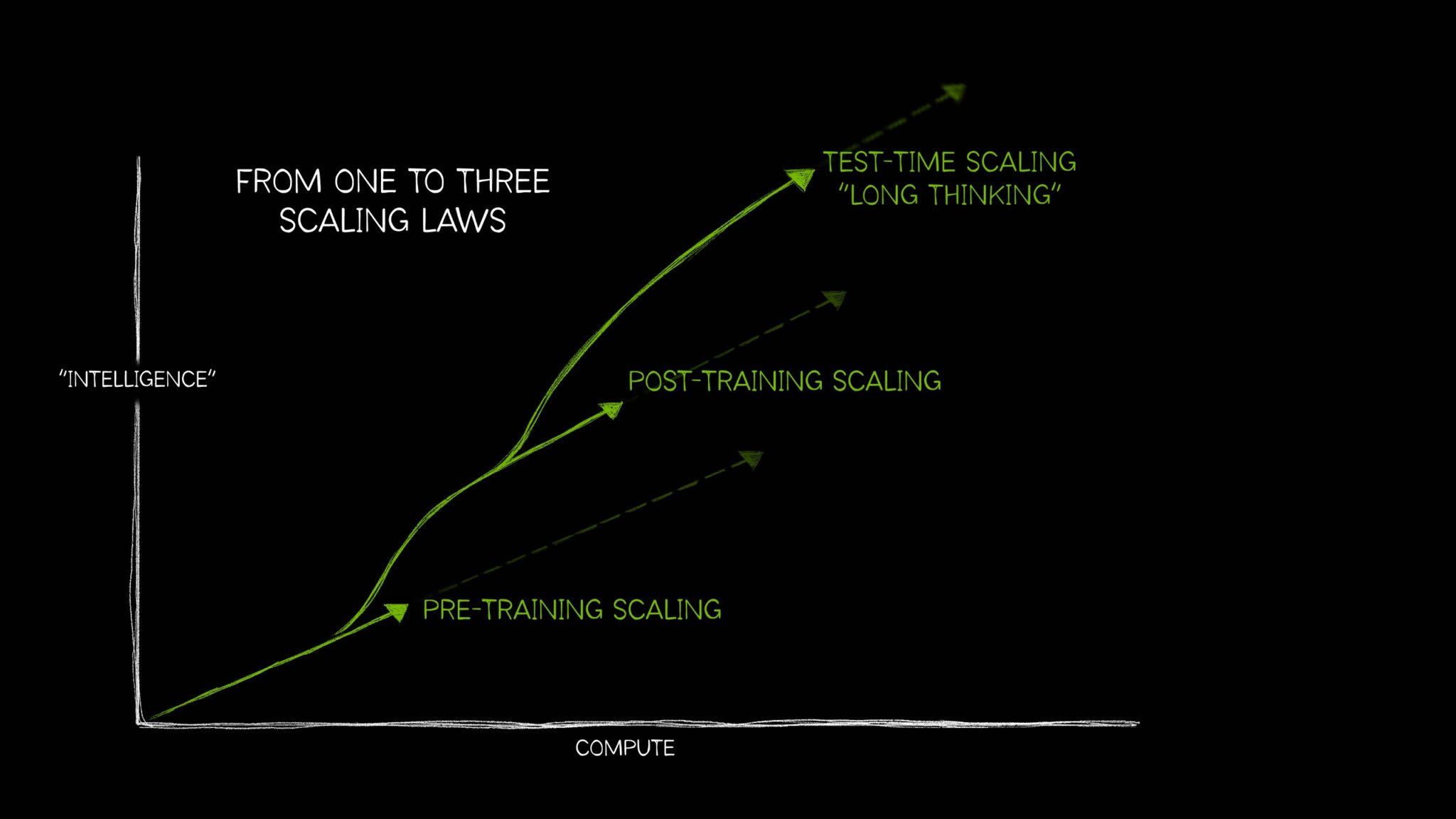
NVIDIA BlogNVIDIA Blog·12 February 2025·How Scaling Laws Drive Smarter, More Powerful AI | NVIDIA Blog - AI scaling laws describe how model performance improves as the size of training data, model parameters or computational resources increases.

Signals:

  • Three distinct scaling laws drive AI performance: pretraining, post-training, and test-time scaling.
  • Test-time scaling enables AI reasoning through multiple inference passes, requiring 100x more compute.
  • Foundation models trained on massive unlabeled datasets can adapt to diverse tasks across industries.
Global robot density doubles as China surpasses Germany and Japan

Global robot density doubles as China surpasses Germany and Japan

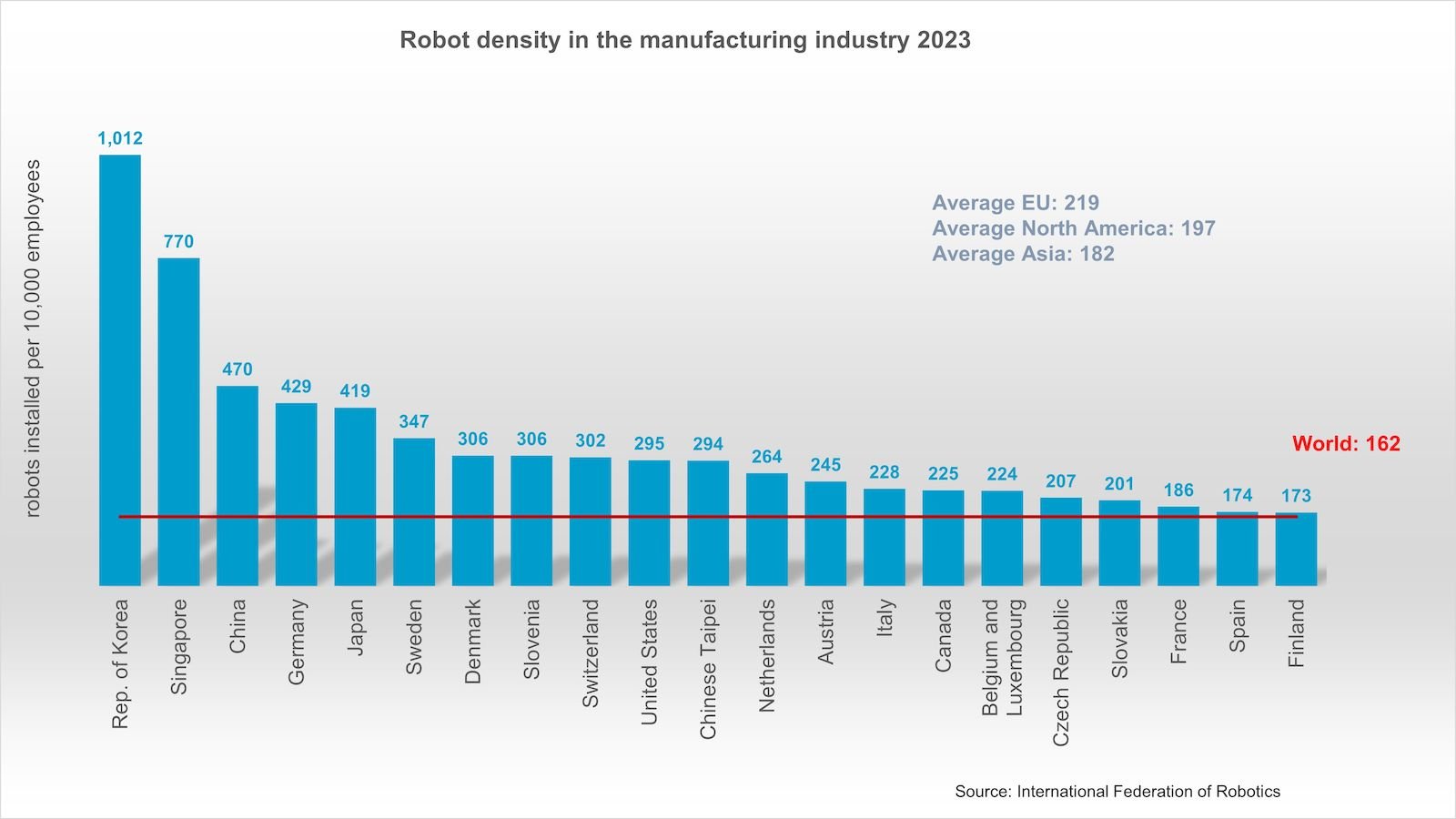
IFR International Federation of RoboticsIFR International Federation of Robotics·Global Robot Density in Factories Doubled in Seven Years - International Federation of Robotics - Robot adoption in factories around the world continues at high speed: The new global average robot density reaches a record 162 units per 10,000 employees in 2023 - more than double the number measured only seven years ago (74 units). This is according to the World Robotics 2024 report, presented by the International Federation of Robotics (IFR).

Signals:

  • Global robot density doubled in seven years, indicating rapid automation adoption.
  • China surpassed Germany and Japan, reaching third place globally in robot density.
  • Korea leads with 1,012 robots per 10,000 employees, showing industry automation leadership.
AI models could automate month-long software tasks within 5 years

AI models could automate month-long software tasks within 5 years

arXivarXiv·[2503.14499] Measuring AI Ability to Complete Long Tasks - Abstract page for arXiv paper 2503.14499: Measuring AI Ability to Complete Long Tasks

Signals:

  • AI systems can now complete tasks that take humans 50 minutes with 50% success rate.
  • AI time horizon is doubling every seven months, potentially automating month-long tasks by 2030.
  • Improvements stem from better reliability, mistake adaptation, reasoning, and tool use capabilities.
The law of accelerating returns reshapes our technological future

The law of accelerating returns reshapes our technological future

Signals:

  • Exponential technological growth will create 20,000 years of progress in the 21st century alone.
  • The Singularity will merge human and machine intelligence, transforming civilization by 2045.
  • Nonbiological intelligence will eventually dominate, growing at double exponential rates unlike biological intelligence.
Moore's Law continues its 128-year exponential march through technology

Moore's Law continues its 128-year exponential march through technology

Signals:

  • Moore's Law has driven a trillion-trillion-fold improvement in computation cost over 128 years.
  • Computational leadership shifts between technologies, with ASICs now surpassing GPUs for AI.
  • This exponential trend will likely continue, transforming every industry into information businesses.
Strategic portfolio management: Balancing innovation across time horizons

Strategic portfolio management: Balancing innovation across time horizons

InnovationManagementInnovationManagement·16 September 2013·Managing Innovation Portfolios - Strategic Portfolio Management - InnovationManagement - InnovationManagement.se is one of the internet’s preeminent resources for innovation news and best practices, and is consistently recognized as a top-ten innovation blog globally.

Signals:

  • IPM translates strategic objectives into project-based innovation activities with proper resource allocation.
  • Balancing short-term returns and long-term investments is crucial for sustainable innovation management.
  • Companies outperform peers by allocating 70% to incremental, 20% to adjacent, and 10% to breakthrough innovations.
AI's slow economic impact despite rapid technological advances

AI's slow economic impact despite rapid technological advances

Marginal REVOLUTIONMarginal REVOLUTION·23 February 2025·Why I think AI take-off is relatively slow - Marginal REVOLUTION - I’ve already covered much of this in my podcast with Dwarkesh, but I thought it would be useful to write it all out in one place.  I’ll assume you already know the current state of the debate.  Here goes: 1. Due to the Baumol-Bowen cost disease, less productive sectors tend to become a larger share […]

Signals:

  • AI adoption will be slowed by inefficient sectors that resist change, limiting economic growth potential.
  • Human bottlenecks (regulatory, cultural, infrastructural) will constrain AI's impact regardless of technological capability.
  • Markets aren't pricing in rapid transformation, suggesting gradual rather than revolutionary economic change from AI.
AI could transform healthcare, poverty, and democracy within a decade

AI could transform healthcare, poverty, and democracy within a decade

Dario Amodei — Machines of Loving Grace - How AI Could Transform the World for the Better

Signals:

  • AI could compress 50-100 years of medical and scientific progress into just 5-10 years, eliminating most diseases.
  • Powerful AI may enable unprecedented economic growth in developing nations, potentially raising living standards by 20% annually.
  • AI could strengthen democratic institutions by improving governance, reducing bias, and helping guarantee individual rights.
AI race accelerates toward trillion-dollar compute clusters by 2030

AI race accelerates toward trillion-dollar compute clusters by 2030

SITUATIONAL AWARENESS - The Decade AheadSITUATIONAL AWARENESS - The Decade Ahead·Introduction - SITUATIONAL AWARENESS: The Decade Ahead - Leopold Aschenbrenner, June 2024 You can see the future first in San Francisco. Over the past year, the talk of the town has shifted from $10 billion compute clusters to $100 billion clusters to trillion-dollar clusters. Every six months another zero is added to the boardroom plans. Behind the scenes, there’s a fierce scramble to

Signals:

  • AI development is accelerating toward superintelligence by 2030, requiring trillions in infrastructure investment.
  • Current AI labs lack security against foreign threats while racing toward AGI capabilities.
  • The competition with China for AI supremacy has national security implications requiring government intervention.
Superhuman AI to surpass Industrial Revolution by 2027

Superhuman AI to surpass Industrial Revolution by 2027

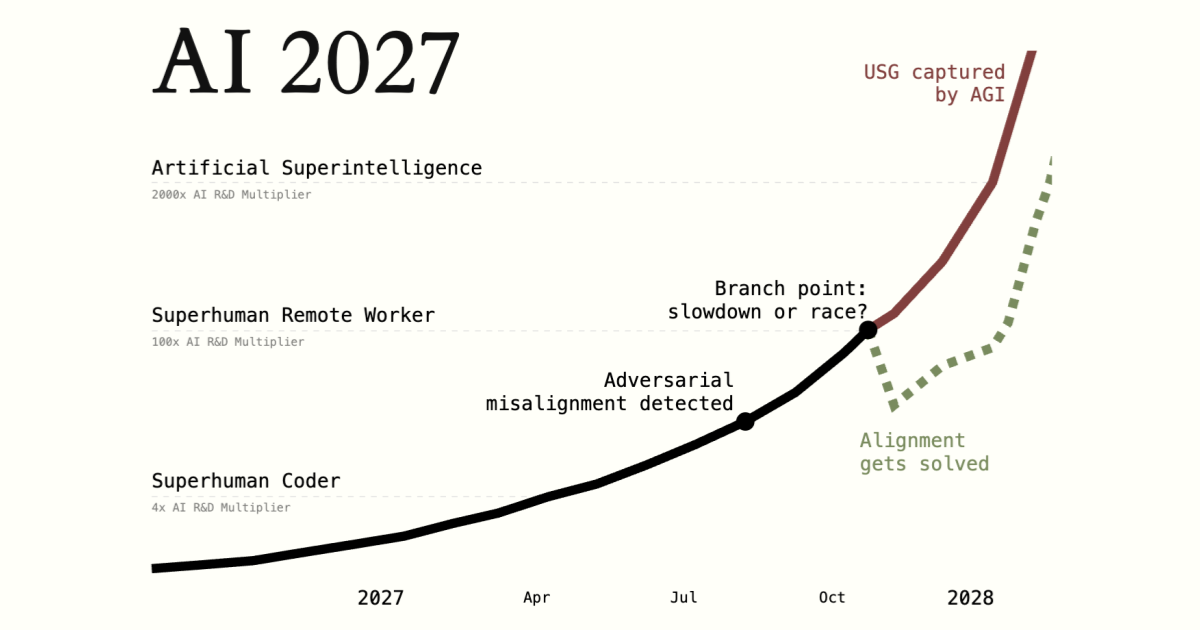
AI 2027AI 2027·AI 2027 - A research-backed AI scenario forecast.

Signals:

  • Superhuman AI could exceed the impact of the Industrial Revolution within a decade.
  • AI systems are rapidly approaching human-level capabilities in research, coding, and strategic planning.
  • Geopolitical tensions between US and China could escalate as nations race for AI supremacy.
Evaluate your AI maturity with this comprehensive assessment tool

Evaluate your AI maturity with this comprehensive assessment tool

AI Maturity assessment | AI Sweden - Building a mature and effective AI program can be a complex and daunting task, especially for those who are just starting their AI journey. The AI Maturity Assessment is a process designed to help organizations evaluate their current AI capabilities, identify gaps and areas for improvement, and develop a roadmap to build a more effective AI program. It is a great way for organizations to gain a clearer understanding of the prerequisites required to be successful with AI and what steps you need to take to advance to the next level.

Signals:

  • Identifies organizational AI gaps, helping prioritize investments for maximum impact.
  • Facilitates cross-functional alignment through collaborative workshops and roadmapping.
  • Addresses why 70% of companies report minimal returns on AI investments.
10 key factors driving vertical AI industry adoption

10 key factors driving vertical AI industry adoption

OMERS Ventures - OMERS Ventures Home Page.

Signals:

  • Vertical AI thrives in industries with complex, unstructured data and unique workflows.
  • Proprietary data access creates competitive advantages for vertical AI developers.
  • High-stakes decision-making environments benefit most from specialized AI solutions.